This is the second post in a series on Starting the Gluten Free Diet. Click here for a list of the other posts in the series. To make sure that you get all of the posts in the series sign up for free email updates in the right sidebar.
For more help getting started on a gluten free diet, make sure to read my ebook The Gluten Free Survival Guide. It’s packed full of practical strategies to help you keep your sanity as you go gluten free!
Have a Budget before hitting the store – Strategies to Lower My Grocery Bill
Our Story:
A gluten free diet can be hard on the pocketbook. Wheat is cheap and it’s in almost every single processed food that I used to buy to keep our grocery bill under control. Back in our college days (pre-GF), John and I used to cook all of our suppers for one month with $40 worth of groceries. If you extrapolate that out, we were spending about $120 a month to provide three meals a day for two people. Of course, we didn’t eat very healthfully. Pasta, white rice, and frozen meals were a staple in those days.
$900+ for groceries
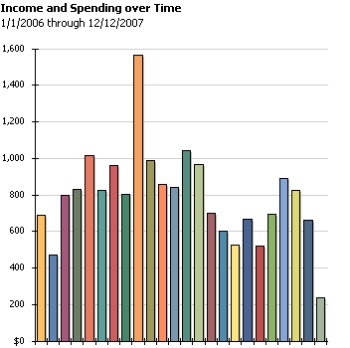
Fast forward to 2006 and our grocery bill had climbed to an average of $900 a month. That’s for two gluten free adults, one gluten free, dairy free infant, and two omnivorous dogs. Anything that we buy at Wal-mart is included in that total, so there are probably some clothes hidden in there somewhere. But still! $900 a month is way to much to spend on groceries.
Tightening the Belt:
Sometime during the first few months of 2007 I decided that I had to take control of the grocery budget. My goal was $600/month. During the year I tried several strategies to reduce the amount I’m spending on groceries, but I haven’t consistently applied all of them at the same time. Even so, I’ve spent less than $600 during four months, and the spending in the remaining months has decreased considerably. The chart below will give you an idea of how I’m doing. It starts in January of 2006 and goes through December 12th, 2007 (when I started writing this post…groan).
A New Year, A New Goal
My goal for 2008 is $400/month. I’ll be applying all 10 strategies that I used this year, but this year I’ll do them all simultaneously. If you’d like to give it a go too, here’s my list:
10 Strategies to Slash Your Grocery Bill
1. Plan your menus.
The first step to smart grocery shopping is to plan what you are going to eat for the week. Check your calendar to see what events you have during the coming week and count how many breakfasts, lunches, and dinners you will need.
Now, take a sheet of paper and make a column for breakfast, lunch, dinner, and snacks. Brainstorm ideas for each meal. If you’re stumped, thumb through your cookbooks, check out your favorite gluten free blogs, or ask your family. Be sure to stick this list on your refrigerator so that you have a quick reference of what you’re planning to cook each day.
I’m going to do my best to post my weekly menu on the blog, and also submit it to the Gluten Free Menu Swap, so be sure to check back every Monday for our new menu.
2. Shop with a list
Shopping from a list is a building block strategy for reducing your grocery spending. The goal is to make a list of ingredients for the meals you’ve just planned, and then only buy the things on the list. I’ve tweaked this a bit and shop from a “pantry list” instead of a regular grocery list.
A pantry list is a pre-printed list of foods that you want to have on hand all the time. I use it as a checklist and go through my pantry and refrigerator every week to make sure I still have everything on the list. If I don’t have something, I mark down how many I want to buy. Once this is done, I add any additional ingredients that I need for the week’s menus, and I’m ready to shop. This strategy alone will keep you from buying item’s you don’t need because you can’t remember whether you have them or not.
3. Set a weekly budget
My budget for 2007 was $600/month. This amount was allocated out by week – $100 a week for Weeks 1 and 2, and $150 a week for Weeks 3 and 4. This was doable as long as I planned to buy dog food, diapers, and toiletries during the second half of the month. The real problem with sticking to the budget was that I was not good at judging how many $ worth of groceries I had put into my cart. I often got to the checkout counter and discovered (to my horror) that I had bought $200 worth of groceries instead of $150.
My solution to this problem was to bring a calculator and pencil along on the shopping trip. When something goes into the cart I write the price down on the back of my pantry list. At the end of every aisle I find a spot where I won’t be run over and tally up my total. By keeping a running list, I’m better able to determine whether I can buy things that aren’t necessities (like hot chocolate and marshmallows…mmm).
I’ve also started highlighting the items on my list that I don’t have to have and I put these groceries into the top part of the cart (where David would be if he were with me). If I get to the end of my shopping trip and realize that I need to put some things back, they are, at least, easy to find.
4. Track prices.
When I find a pantry item at a good price, I like to stock up. However between blogging, work, and home I can’t keep up with all of the prices in my head. My pantry shopping list can though.
Here’s how it works. The first time that you shop with the list, jot down the price of each pantry item that you purchase in the price column. When you get home, type that price into the spreadsheet so that it will print out on next week’s list. Every time that you shop, check the prices again. When you find a lower price, just mark through the old one, write down the new price and update your list when you get home. Within a few weeks you’ll have figured out the rock-bottom prices at your grocery store and you’ll know a good price when you see one.
5. Monitor “in-between” trips
Trips to the store during the week are my budgeting downfall. I never save any money for these trips, so pretty much anything we have to buy between big shopping trips is outside of our budget. And we always buy more than we on into the store for.
The only solution that I see to this problem is to do a better job of planning meals and making my grocery list. This year I’ll be saving the receipts from my in-between shopping trips so that I can analyze what I’m buying. I think that I’ll find that I need to add some more items to the pantry shopping list. I probably also need to do a better job of anticipating how much snack food we’ll need. And there may be additional issues that I’m not aware of. Monitoring the receipts should give me some answers, and possible some new strategies for saving.
6. Set a maximum $/pound.
When I shop I try to only buy food that is less than $1.99/lb. For me this has been a pretty easy strategy because I tend to shop around the edges of the grocery store, where most products are sold by the pound. Think produce and meat (well not meat for us, but you get the idea). If I find a great deal on a food that will store well (like potatoes) I stock up. Otherwise I just try to keep in mind the foods that are usually under my price limit and plan meals around them.
7. Shop from your pantry.
Before I even sit down to plan my weekly menu, I peruse the pantry, refrigerator and freezer to see what foods I have on hand. Usually I find that there is some sort of produce that needs to be used, or a pantry staple that has been lingering in the cupboard. These items become the foundation of of my menu for the week to ensure that I’m using what we have and not buying food we don’t need.
8. Do your own food prep.
In short, the more that fresh foods are processed the more they cost – boneless, skinless chicken breasts cost more per pound than a whole chicken. So, if you want to reduce your grocery costs, start prepping your own food.
Before we switched to a vegetarian diet I would often buy large packs of bone-in chicken breasts and then spend 30 minutes or so deboning all of them and packaging them for the freezer. It’s not a fun job, but it’s not really that difficult and it saves money.
Produce, on the other hand is something that I don’t mind prepping. In fact it’s sometimes fun to whack a big chef’s knife into a head of cabbage. Food prep is a learned skill, and the more you practice the faster you’ll get. Check the Lessons Index for a few lessons on veggie prep.
9. Drink more water; eat healthier snacks.
Okay, this one may be tough. Stop spending money on food that is bad for you. My philosophy on this is that my grocery dollars are precious and they need to provide as much nutrition as possible. We have almost completely eliminated junk foods and sweets from our diets. If we do have them, we make them at home.
Not eating junk food is a habit that we worked on over time. If you try to cut it out overnight you’ll probably feel deprived and discouraged. Instead we eliminated things from our diet as we were ready to give them up. For instance I stopped eating ice cream when dairy foods started causing a lot of tummy issues. Other items fell out of our diet when we went gluten free or vegetarian and we’ve just never bothered to replace them.
We are currently working towards reducing our chip and beer consumption. Instead of chips we are using more fresh veggies for dipping and we’re trying to figure out how to bake tortilla chips in the oven.
10. Eat less meat and dairy.
I have to admit that before we switched to a vegetarian diet, I wouldn’t have liked this idea. I associated vegetarian meals, especially those filled with beans, with poverty. I also couldn’t imagine that beans could taste good since they never had in my experience.
Now that we’ve been vegetarian for almost 18 months I completely disagree with myself. The main reason that we decided to stick with a vegetarian diet after we completed a 30-day trial was that the food was so much more flavorful than what we were accustomed to.
All that said, beans and tofu are much cheaper than meat. Even if you just eat vegetarian for a few days a week you should see some cost savings. Be adventurous and explore some new recipes and you might just surprise yourself.
I should caveat this by saying that soy and rice based dairy products are usually more expensive than cow based. We still eat cow cheese and sour cream, but we have greatly reduce the amount of these foods in our diet. Over time our taste buds have adjusted and we find it easier to use smaller amounts.
Making a Grocery List
After reading the first post you should have a good idea of what you will be eating for each meal this first week. The next step is to make your grocery list. If you’ve never done this before, start by grabbing a sheet of paper and listing categories that match the general layout of your grocery store. I usually use PRODUCE, FROZEN, DAIRY, MEAT, CANNED GOODS, DRY GOODS, and HOUSEHOLD.
Now, go through the list of your meals and write down each ingredient that you need to buy. If you’ve followed the instructions in What to Eat on a Gluten Free Diet, then there will be a lot of whole foods listed on your sheet and very few processed foods, if any.
Remember, on this first shopping trip the goal is to read as few labels as possible. If you will be using foods that you already own in this week’s menu, be sure to check to see if they are marked “GLUTEN FREE”. If they are not and they contain any processed products I would strongly recommend that you change your menu to not include these foods. Reading labels is the most depressing and tedious part of a gluten free diet and I’d love for you to be able to avoid that until you’ve had at least a week to adjust and do some reading.
If there are some essentials that you need to replace – like mayo, ketchup, etc., consider shopping at Walmart this week. Walmart’s store brand, Great Value, is very good about clearly marking all of the gluten free products on the label.
Absolute No-Nos
Wheat is so ubiquitous in the Standard American Diet that we often forget that we are eating it. Here are a few foods that you may not realize contain wheat.
- all-purpose flour
- self-rising flour
- semolina (the flour used in most pasta)
- couscous
- most soy sauce
- Campbell’s Cream of ______Â Soup
- cornbread mix
- most cold cereals (barley malt flavoring)
At the Grocery Store
The best tips that I can give you for the grocery store are to stick to the outside aisles and whole, unprocessed foods. Follow your grocery list and look forward to feeling better during the coming week. While you’re there ask the service desk if they have a list of gluten free foods that they stock. Also check to see if you they have a special location for gluten free foods, or if they shelve them near their gluten-filled counterparts. This knowledge will help you plan for next week’s shopping trip.
You may feel that my advice to only eat unprocessed foods and foods that are clearly marked “Gluten Free” is overly restrictive. But I really do want you to feel better quickly, and the easiest way to accomplish that is to get ALL of the gluten out of your diet. And it’s only for a week. By next week you’ll have learned more about identifying gluten in foods, what foods are naturally gluten free, and where to buy gluten free foods that your local grocery doesn’t stock.
What’s in a Frugal Gluten Free Pantry?
This is the fifth part in a series “Gluten Free Grocery Shopping on a Budget†in which Heather shares how she feeds a family of 6 a gluten free diet for $350 – $400 a month. In this last post, Heather gives us a peak into her pantry.
My biggest grocery savings has probably been in avoiding convenience foods, and developing a repertoire of menus we like that don’t use expensive ingredients.
Some of our recent meals
Breakfasts:
Cappucino Chocolate Chip Muffins w/ Fruit, Pancakes w/ Fruit Syrup, Hot Gluten-Free Cereal, Granola (for rest of family and Clif Bar for me)
Lunch:
PBJ sandwiches for rest of family, 5-bean casserole, baked beans, macaroni salad (with Tinkyada pasta), leftovers
Dinners:
Spaghetti, Mashed Potato & Sausage Casserole, Pancakes and Scrambled Eggs, Bean Burritos, Smoked Sausage and Rice Casserole, Steak and Baked Potato, BBQ Ribs and Homemade French Fries, Beans with Diced Tomatoes and Seasoning
Following is a list of my standard ingredients on hand:
Pantry
Baking Ingredients
- Brown Rice Flour, White Rice Flour, Sweet Rice Flour, Cornmeal, Potato Starch, Tapioca Starch, Cornstarch, Xanthan Gum
- Baking Powder, Baking Soda, Cream of Tartar, Salt
- Sugar, Brown Sugar, Honey, Molasses, Powdered Sugar
- Cinnamon, Nutmeg, Ginger, Cloves, Allspice, Vanilla, Almond Extract
- Instant Coffee (for baking only)
- Canned Pumpkin, Unsweetened Applesauce
- Cocoa, Chocolate Chips
- Oats (regular oats to make granola as a quick meal for rest of family)
- Almonds
- Oil, Shortening
- Rice Milk or Almond Milk
Condiments and Seasonings
- Black Pepper, Garlic Powder, Italian Seasonings, Basil, Onion Powder, Chili Powder, Caraway Seed, Powdered Chicken Buillion
- Ketchup, BBQ Sauce, Mayonnaise, Tartar Sauce, Taco Sauce, Vinegar, Worcestershire Sauce
- Peanut Butter, Jam, Real Maple Syrup
Other Staples
- Tinkyada Brown Rice Pasta for me, Whole Wheat Pasta for Family
- Brown Rice
- Dried Pinto and Great Northern Beans
- Spaghetti Sauce, Diced Tomatoes, Crushed tomatoes
- Potatoes
- Tortillas (Some wheat for rest of family, corn for me)
- Bob’s Red Mill Hot Gluten-Free Cereal
- WW Bread (starting to buy 2 loaves a week for family, so that leftovers only have to feed me at lunch)
Snack Items
- Peanuts, Raisins (both bought in large quantity)
- Tortilla Chips, Salsa (have about 2x a month as a treat)
Fridge Items
- Dairy-Free Margarine
- Eggs
- Cow’s milk (for rest of family)
- Cheese (for rest of family)- bars and shredded
- Plain Yogurt or Sour Cream (for rest of family)
- Cabbage, Carrots
Freezer Items
- Boneless Skinless Chicken (some pre-diced)
- Catfish Nuggets
- Beef Steaks and Roast (less than $2.29/lb)
- Pork Ribs (less than $1.50/lb)
- Ground Beef (less than $1.59/lb)
- Pork Sausage (less than $1.59/lb)
- Polish Sausage ($2/lb)
- 100% frozen juice concentrate
- Frozen Broccoli, Peas, Corn
- Other items from garden or local orchard (strawberries, apples, peaches, etc)
Occasional Convenience Treats
- Instant Unseasoned Potato Flakes (use about 2x a month)
- Canned Tuna (use about 2 cans 1x/month)
- Canned Beans for 5-bean casserole (use 4 cans about once a month)
- Canned Baked Beans (use about 1 can per week)
- Clif Bars (use 1 a week on average)
- Marshmallows (about 1 bag every few months)
- Nondairy creamer (use about 1 cup a month to make pudding or hot chocolate for myself)
- Tea Bags (about 4 bags a month, usually reuse at least once)
Other Resources
Buy Gluten Free food online
If you’re lucky your local grocery store will carry a wide selection of gluten free foods. If they don’t it’s easy to find a wide array of gluten free products online. Here are some of the sites where I shop, as well as a few that other readers have recommended:
- Amazon’s Gluten Free Groceries Page
- Bob’s Red Mill Gluten Free product page
- Gluten Free Mall
- Azure Standard
- glutenfree.com

Gluten Free Grocery Guides
Grocery guides will save you a lot of time and grief when you’re in the grocery store. They are also helpful when you are planning meals. It’s nice to be able to look and see whether there is such thing as gluten free taco seasoning before you get to the store.
- The Essential Gluten-Free Grocery Guide by Triumph Dining
- Cecilia’s Marketplace – Gluten Free, Gluten Free Casein Free, and Gluten Free Casein Free Soy Free
- Shopwell.com
Gluten Free lists from Grocery Stores
Many grocery stores provide lists of the gluten free products that they carry. Be sure to check these lists frequently for updates.
- Acme Markets
- Farm Fresh Supermarkets
- Albertsons
- Cub
- Hornbachers
- Jewel – Osco
- Kroger
- Publix
- Shaws
- Wegmans
- Whole Foods
Gluten Free Product Lists by Food Manufacturer
Here are several resources for finding gluten free products by manufacturer.
- General Mills Gluten Free Product List
- Hormel Foods Gluten Free Product List
- Celiac Society Manufacturer Search
- Certified Gluten Free Products Search
Pingback: Getting Started on a Gluten Free Diet | Gluten Free Cooking School
I have found that Publix’s Greenwise sections are good resources, if I don’t want to go out of my way. In some stores they’re separate sections, and in some there’s a small section on each aisle. I have found, however, that management isn’t very knowledgable about gf, which is a little disappointing in a retail grocery store. But their prices on some of the Bob’s products are lower than my local health food store & WF. Just a bit hit or miss on what they stock. Fortunately, I have like 5 Publixes within 10 miles, so I’m covered 😛
Look at http://www.glutenfreediary.com to see some suggested foods to include in a weeks gluten free balanced diet
[…] One: 1. Figure out what you’re going to eat for the next week. 2. Go grocery shopping. 3. Cull your gluten contaminated cookware. 4. Start learning about what foods contain gluten and […]
This is a great resource for parents and caregivers of autistic children. The more parents know what to look for and what to avoid, the more successful they will be to sticking to a GFCF diet.
I know that it is a little late, but now brand name Corn Chex and Rice Chex are officially gluten free! (NOT the store brands so make sure to check). Look for the new boxes labeled gluten-free! (much cheaper than most of the specialty gluten-free cereals and still tasty)
Also, Kix brand name cereal no longer contains oat flour or malt; however, it may still have some cross contamination, so be careful.
There seems to be just a little something odd with your site when opened in ie 7. Its wierd because everything is all twisted up looking. might want to have a look.
I have gluten allergy since childhood. I am always on a Gluten Free diet and i use guar gum in some of may baked foods.
What does Cull your utensils mean?
I just found out yesterday that I have to eat gluten free.
I see everyone saying Cull your utensils. Huh?