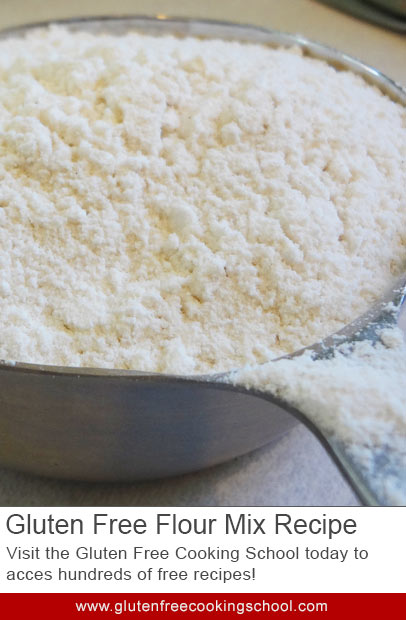
This is the first post that I wrote for this blog and it was time for an update. I’ve added the weights of the flours and changed a few of the alternative ingredients to reflect the flours I use now. Even six years later, this flour mix is still my first choice when I’m converting a recipe to gluten-free status.
My homemade gluten free all-purpose flour mix is the gluten free item for which I most often reach. After almost ten years of cooking gluten free, I am amazed at how well this mix works in so many different recipes.
When I make gluten free biscuits with this mix, they taste like biscuits. When I make gluten free pancakes, they taste like pancakes. I’ve even made onion rings with this! I know I’m a geek, but this really is exciting!
When I first started cooking gluten free foods, I bought a basic gluten free cookbook and rushed home to bake some goodies for my husband. I eagerly flipped to the section on flour blends and was incredibly disappointed to find that I did not have any of the ingredients on hand, and had no idea where to buy them.
You’ve probably had the same experience!
Eventually I developed my own Gluten Free Flour Mix that uses gluten free flours that are relatively inexpensive and widely available in grocery stores. That’s the recipe that you’ll find below. Many of the baking recipes on the blog (and in my cooking classes) utilize this gluten free flour mix.
Instructions
- 210 g (approx. 1.5 cups) brown rice flour
- 195 g (approx. 1.5 cups) corn starch
or tapioca flour
- 110 g (approx. 1 cup) sorghum flour
or garfava flour
- 55 g (approx. 1/2 cup) masa harina

The brands that I use are Bob’s Red Mill brown rice flour, sorghum flour, garfava flour; Argo cornstarch; Maseca masa harina, and Bob’s Red Mill or EnerG tapioca starch.
Tips for Measuring Gluten Free Flour
This recipe has been on the blog for years, and it was originally given as a volumetric ratio of 3:3:2:1. That is, I would use 3 cups brown rice flour, 3 cups corn starch, 2 cups sorghum flour and 1 cup masa harina. Or if I wanted a small batch of flour, then I would grab a 1/4 cup measure and use 3/4 cup each of brown rice flour and corn starch, 1/2 cup sorghum flour, and 1/4 c. masa harina.
While you’re still welcome to follow that ratio, I have since begun measuring by weight instead of volume. Weight measurments are much more accurate for flours, and if I measure by weight and you measure by weight, then we’re much more likely to get the same results with my recipes. That’s a good thing!
The only disadvantage to weighing this flour mix is that the weights are not easy to remember. Make life easy on yourself and jot down the weights on a piece of paper and tape it to the inside of a drawer or cabinet in the part of the kitchen where you do your baking.
Instructions for Mixing and Storing Gluten Free Flour Mixes
Combine all the flours in a large bowl and mix thoroughly. If you’re new to mixing flours, the goal here is to not see any clumps or streaks of indiviual flours. By the time you’re done it should be one homogeneous bowl of flour. Transfer the flour to a canister or other air-tight storage container and you’re done!
Since I use this mix so often, I usually make up a very large batch and store it in a large canister so that it’s ready whenever I decide to bake. I do keep my flour canister on the counter, but I go through it pretty quickly. If you don’t bake often, then you may have better luck storing the flour in a freezer bag in the freezer, so that the flours do not become rancid.
I’ve gotten several questions about flour mixes lately, so I threw together this post that summarizes a lot of information that’s currently spread around my blog in various places. If you have any additional questions, just ask them in the comments and I’ll answer them and somehow incorporate the answers into this post. If you’d like to learn more about why you have to use so many different flours together, what the flours do, and which gluten free flour mix is best for you, make sure to read my ebook, The Gluten Free Survival Guide. Chapter 7 is devoted to gluten free cooking, and you’ll get all of your questions answered there.First, here are the recipes for my flour mixes.
My all-purpose gluten free flour Mix
- 3 parts brown rice flour
- 3 parts corn starch
- 2 parts soy flour
- 1 part masa harina
Gluten Free, Soy Free, All-Purpose Flour Mix
- 3 parts brown rice flour
- 3 parts corn starch
- 2 parts sorghum flour
- 1 part masa harina
Gluten Free Cake Flour Mix
- 1 part brown rice flour
- 1 part sorghum flour
- 1 part tapioca starch
Instructions:
- Depending on how much flour mix you want to make, choose a measuring cup. If you want 9 cups of mix, use a 1 c. measure. If you just need a tad, you can use a 1/8 tsp. measure =)
- Whichever measure you choose is now a “part”. Scoop out the appropriate amounts of each flour and pour into a large mixing bowl.
- Sift/whisk/stir the flours until they are extremely well combined. No streaks of corn starch allowed.
- Store in an air-tight container in your pantry, refrigerator, or freezer depending on how long you think it will take you to use all of the mix. The colder the storage area, the longer the shelf life of the flours.
Common Substitutions:
- For the corn starch: tapioca starch (also called tapioca flour), potato starch, arrowroot flour
- For the masa harina: almond flour
My Recipes That Use the Flour Mixes:
- Gluten Free Banana Bread
- Gluten Free Blueberry Scones Recipe
- Pancakes
- Spiced Apple Pancakes
- Drop Biscuits
- Pizza Crust
- Flour Tortillas
- Garlic Cheese Biscuits
- Yummy Sandwich Bread
- Gluten Free Sandwich Bread
- Sugar Cookies
- Red Velvet Cake
- Double chocolate gluten free brownies
How to Use Gluten Free Flour Mix in Your Own Recipes:
- If you have a gluten free recipe that lists several types of flour, sum the amounts of each flours and substitute an equal amount of flour mix.
- Check the recipe that you’re altering and make sure the ratio of flour:starch is about the same as in your flour mix. For instance the flour to starch ratio in my mixes is somewhere between 5:4 and 6:3. (The masa harina acts somewhat similarly to a starch – it absorbs a lot of water). If the recipe that you’re converting has a 3:4 flour to starch ratio, then the recipe author has added additional starch to “lighten” the recipe. If you are confident in your math abilities, then you can probably figure out how much additional starch to add. Otherwise, find another recipe for this type of experiment.
- If you’re converting a recipe that uses regular wheat flour, start with a 1:1 substitution of one of the gluten free all purpose flours and add 1/2Â – 1 tsp. xanthan gum. If the recipe is not as tender as you would want, then replace some of the flour with additional corn starch next time. If the baked good is too tender, then replace some of the flour with brown rice flour, soy flour, garfava flour or sorghum flour. It may take some experimentation, but most gluten free baking does.
How long can you store these type of flours in a airtight container?
I bought some tupperware ones at a garage sale thinking they might work! But, someone suggested putting it in the freezer if you don’t use it fast enough>? So, what is the rule of thumb,,,,,,,,,use it or freeze it by?
@Chelle: My rule of thumb is a couple of weeks in the pantry, a month in the refrigerator and 6 months in the freezer. I don’t know that there’s any science behind that though =)
Pei,
I have a cook book that would be a help to you. It lists many recipes with different kinds of flour in the same recipe! It also teaches on oils, egg replacement, and other problem issues. It is not hard to use, and has been very helpful to me. The book is “Allergy and Candida Cooking.” It is by Sondra Lewis with Dorie Fink. She discusses many health issues other than allergy and candida. My allergy clinic recommended it.
Sondra has allergies herself and is a scientist and a doctor. She has done a lot of research. He web site is http://www.canaryconnect.com. 319-338-3827 I have received personal emails from her.
About my pie recipe in #157, I discoverd something. This week I made it with Amaranth flour, rolled it between parchment paper, added a little more olive oil, until less crumbley, and baked it in an aluminum pan instead of glass. It worked super well!
About my pie recipe in #157, I discovered something. This week I made it with Amaranth flour, rolled it between parchment paper, added a little more olive oil, until less crumbley, and baked it in an aluminum pan instead of glass. It worked super well!
Rita,
Am thinking about your husband’s problem. Elemination diets may help, but not always, because sometimes it takes up to 48 hours for allergies to show up that way! Somethings are obvious, some are not.
When I was tested, they found 22 food sensitivities, many of which I had no idea.
One thing that is helpful is to leave out “anything you can’t pronounce” on the ingredients label. In other words, mixes are out, unless they are from the health food store, and then you have to read it carefully! These things don’t show up on a test, but are very real threats.
Praying for you, girl. There are answers, but sometimes it takes awhile to find them.
This chat room is an excellent place to start! Thanks to Mary Frances and many others, I have recently found solutions to problems that I had not found other places.
I close out now to prepare for my husbands birthday: Enchilladas and chocolate sour cream cake are on the menu. They are a lot of trouble and I cannot eat a bit of them! Girls, this is the hardest part of the whole situation for me. I will take out some meat and spices before I add the tomato sauce and then I will make mine with a rice tortilla with white cheese instead of colby. (I even like it now, but it took some getting used to!) There is no substitute for the cake, except that I made a banana bread recipe yesterday, so will at least have some dessert. Every meal that I fix is like this one; eating out or at pot luck dinners are are hard, too, and it really got to me at first. Then there are the “loving” doubters who think there is nothing to it, and I am just a fanatic.
I am so refreshed to read of all of your interest in hitting the problems head on and having a cheerful, thankful attitude that there can be solutions to the problems!
God bless you every one!
Alice #108
For yeast free recipes, see #161. Yeast is one of my big problems, both as an allergy and in Candida! There IS help, but lots of adjustments to make!
I just ordered a book called Gluten-Free Baking with The Culinary Institute of America by Richard J. Coppedge & Chookazian, George. I graduated from the CIA in 1977. I have wanted to take one of their gluten free baking courses for a few years now but they are always at an inopportune time and very expensive when you take into consideration lodging and food. I’ll let you know how the recipes work!
I have problems with all corn and potato products, as well as gluten and wheat, so I am looking for a bread recipe or all purpose flour recipe without corn or potato starch. Is there such a recipe?
Michelle,
Try 2 parts white rice, 2/3 part Sorghum flour, and 1/3 part tapioca flour.
I cannot use corn or wheat, either, so do know how hard it is to use a lot of GF recipes.
Gloria,
My problem with soy is that it puts me in the bed for about three days at a time. I also had an experience once thinking soy was good and was delighted to find a meal substitute. I was soooo sick, and called my doctor. He said to get off the soy immediately!
If you can do soy, count your blessings, as there are a lot more gluten free recipes with soy than without. Each of us has different things that we can tolerate or can’t.
May you find the foods that give you optimal health!
Someone was asking about sweetners, but am not finding the post right now. I use honey, sorghum, and agave for sweetners, for the same reasons you listed for not use other sweeteners.
I can not say I do not still miss sugar once in awhile. I do use Xylitol, but it must be the kind that does not have corn in it. I found that in Smart Sweet Xylitol on the net. It tastes a whole lot like sugar and can be used the same way, but I can get too much of it, so I just add a couple tablespoons. I often mix a couple tablespoons of Maple Syrup and a 1/4 cup of agave for sweetening. I am not sure these can activate yeast, but if I could eat yeast, I would sure give it a try!
Alice, have you checked out Mary Francis’s bread recipes on this site? She has a number of them, and they are a big help. Click on recipes, and you will find them.
Go to http://www.mercola.com and do a search on agave syrup. It’s high fructose corn syrup and should be avoided. I use xylitol, but your body has to build up to larger amounts, so have a bit each time and gradually increase, or you may have gastrointestinal discomfort. It’s alkaline, as well, for those who follow those guidelines and good for your teeth. 🙂
Oh, you scare me! I have his book on sweeteners and have paid alot of attention to what he says about them. I do not find agave on his site, so must be missing it. I see corn syrup.
The agave that I get at the health food store is organic made purely form salmiana variety of agave with no additives or preservatives in it. I am very sensitive to corn syrup, and have no problems with this agave.
Can you give more info on where to find the article? I want to know more about it, as do not want to play with fire! Thanks.
Pamela’s Pancake mix makes marvelous dumplings. I made the biscuit recipe on the bag, which is really simple. When my broth was boiling, I dropped the biscuit dough into it by spoonful and used the same time for biscuits, with lid on the pot. I Added the cooked chicken and then I took it off for a few minutes and served it.
I also put stuffing spices in one batch and doubled the liquid. I baked it in a small baking pan. It was tasty with chicken!
Anyone who has no problems with almonds or rice will love this mix, esp if you have tried other gluton free. Mary Frances has a link on this site for it.
Lori, please report on that book when you can. It sounds good.
What can be substituted for the soy flour? We use Bob’s Red Mil floursl, since it is local and they have a great gluten free facility – but their soy flour is not processed in their gluten free facility. When we asked them they noted that it is not used much in gluten baking and they don’t have the demand for it. Also, I would prefer to avoid soy with teenage girls in puberty.
Pingback: Gluten Free Waffles | Gluten Free Cooking School
I cannot thank you all enough for the wonderful comments and experiments. We have been gluten free for all of less than a week and I have been feeling a little overwhelmed at all of the baking that has changed! I love to cook and bake and my girls do as well, but since both my daughter and I (and possibly my dh and other daughter) have gluten issues (just the 4 days and my daughter in particular has shown improvement. Today was the first day in 4 years that she has not had digestive issues) I was afraid we may have to use prepackaged mixes after all the years I tried to learn from scratch! THANK YOU!!!!!
I am new to gluten free, and while I have found much of this useful, I remain a little confused. What determines the ratios of the flours? Are there sets that are interchangeable, but others that are not? (As in, sorghum can sub for soy, but not for rice?) On hand already I have rice flour, tapioca flour, potato starch, coconut flour and fine corn meal. Is there a usable blend somewhere in there?
Thanks!
First time here….love it!!! All posts where very helpful. I’m looking for a flour blend for dumplings (w/a Chicken & Dumplings receipt ;). Not the ‘drop dumpling’ type,
roll-out the dough and cut into squares type. Some people call it ‘Chicken & Pastry’. My mother & grandmother made the best. Both have passed away and I never learned to make it.
Just for info purposes, my son has eczema that is GREATLY worsened if he has rice. However, we have found that he has NO problem what so ever eating ORGANIC rice. I have also discovered that he is gluten intolerant, and have had great success with a gluten free diet. Searching for gluten free products with organic rice flour in them has been a difficult journey, though. Someone sent me instructions online about how to make my own rice flour today, and I’m definitely going to give it a try!
http://hubpages.com/hub/An-illustrated-Guide-to-Making-Rice-Flour
I’m curious about his flour mix. I am trying to do the sugar cookie recipe. How much Xanthan gum should I use?
Hola from Mexico,
I am an expat (just found out I am lactose and gluten intolerant) that is looking for a gluten free sour dough bread recipe ………. I thought I saw a comment a couple days ago that someone made this and without using sour dough starter…. ??? I went through the comments again today and I obviously missed it.
I would really appreciate having this and making it for myself.
By the way this is a great site and have gotten so much help from this place.
Just wanted to encourage everyone to consider using a nutrimill grain mill. I love mine and it has been extremely useful in making my own bean and rice flours. I’ve noticed that my fresh ground bean flour (navy bean) began to get “beany” tasting about 4 days after being ground. But using 1/2 bean flour and 1/2 rice flour in place of all purpose flour and then just following a regular pancake recipe–oh my, the results were incredible. Looking forward to trying your tortills recipe. Thank you for sharing!!
i would like to make my gluten free sister the same dessert as for everyone else. 1 inch dense white cake, chocolate ganache, white chocolate raspberry mousse, chocolate ganache. will this flour work? also there are 2 tsp cornstarch in the mousse. will that be a problem?
Hello Mary! Love your site =)
To anyone that cannot eat soy or other foods:
I would recommend almond, oat or quinoa to substitute the soy flour in Marys Mix. If you are have problems with soy, potato, rice, corn, etc you should also try and see if organic helps. Me and my son have celiac’s disease and an intolerance to soy, so even organic soy doesn’t make it better for us :/ But I have a friend who can only eat organic soy, if the soy isn’t organic she has a ton of problems.
Eliminating soy and gluten worked wonders for us but we did continue to have problems with eczema and bouts of upset stomach. So I tried buying organic veggies and fruits especially potatoes and now we are eczema and tummy ache free.
Through the years I have realized that pesticides, chemicals, fungicides, etc are the main culprit of me and my sons intestinal problems and eczema. Organic can be pricey but some foods carry more toxins then others. Here is a list of foods that is on my top list of organic foods. http://www.thedailygreen.com/healthy-eating/eat-safe/Dirty-Dozen-Foods
Jay in NZ: If you would like me to mail you some Masa Harina, please say. I am a Texan of Kiwi descent, so I do sympathise very much! Here in Texas, Masa Harina is a very, very common food item.
Let me know. I too, have coeliac, and I know it’s challenging enough without being able to find some food items!! Cheers, mate.
Kind regards,
Jude 🙂 xo
Random Question… I have noticed that most recipes for call for Rice Flour, Soy Flour or Corn Flour. Unfortunately, I am allergic to those items. I try to avoid them as much as possible. Any ideas for substituting them in your recipes would be a welcome relief.
Thanks for all of your hard work!
Hi,
I have been working on a wonderful GF flatbread using ancient grains for a long time and am now starting my own company calle Zema’s Madhouse Foods, inc. I have a line of GF flatbreads(soft and chewy) and will be coming out with baking mizes in a few months. My breads are yeast free, soy free, dairy free, rice free, and are a great source of protein, omega’s and complez carbs. I started this business due to my kids(I have 5) adhd, as well as my husband. They love them. You can contact me at jill@zemasflatbread.com and I can try to help you with some options.
Pingback: Bread Recipe: Gluten Free Cooking School Sandwich Bread | Gluten Free Portland Oregon
I mixed up just enough of this to make your pancake recipe and since I didn’t have the masa harina on hand I substituted quinoa flour. I thought it was wonderful! On one of your posts you mentioned not liking the beany flours and up to now that’s been the only pancake or flour mixes I’ve been able to find in the stores – mixes that include bean flours. It’s been awhile since I’ve eaten wheat flour, but this mix sure made pancakes that tasted like the real thing to me. Thanks so much!
I reside in Canberra, Australia and there’s a bakery right near me that is entirely grain-free (they use no grains/grain derivatives in any products on premises). I’m allergic to soy as well as coeliac, and finding alternatives has been hard. The aforementioned bakery, however, sells a few items that are soy free as well including rolls which contain water, quinoa, tapioca, sugar, canola oil, salt, sesame seeds and guar gum. Their products are delicious!
From here, there has been greater awareness now for individuals with multiple allergies and additional requirements as well as coeliac disease.
I guess this is no help to you, I’m sorry. Haven’t been to the States for a while but I’d hope things are steadily getting easier over there, too.
I used this flour blend to make my old German Pancakes recipe, and it turned out great! Of course it looked quite different (it was a little grey-ish and the crust didn’t curl up on the edges), but it was as tasty as it always was with wheat flour. Try it if you’d like:
3-5 Tbsp butter (more tastes a little better but less is healthier)
6 eggs
1 cup flour
1 cup milk
1/2 tsp salt
Melt the butter in a casserole dish in the oven while it heats up to 425 degrees.
Mix eggs, flour, milk, and salt until smooth.
When the butter is melted and the oven is hot, slowly pour batter into dish with the butter.
Return to oven and cook for 20 minutes (until a knife or toothpick inserted in the middle comes out clean).
Some of my favorite toppings are blueberries and honey, fresh lime juice and powdered-sugar, or yogurt.
We are very anxious to trying your recipes but we have been unable to find sorghum flour where we live in Costa Rica. We found soy flour but we don’t really like it unless it is extremely necessary: the question then: is there a substitute for sorghum flour? In Costa Rica we have been able to find: Potato Starch, Pejibaye (Bactris gasipaes HBK) Flour, Tapioca Flour, Sweet Potato Flour, Cornstarch, White Rice Flour, Chickpeas Flour, Soy Flour basically.
By the way, we don’t find Brown Rice and I would like to know if I can use White Rice Flour instead.
Thanks a lot in advance for your help.
Hi, I just tried the bread recipe. Thanks so much! I had all but given up on a tasty GF bread. Great texture and taste. One question- my loaf was only 4″ tall, did I do something wrong or is this normal. I tried to follow the recipe closely; beat it for a couple min. before adding to the machine, also. Thanks for any input.
Also, would like to know if you have perfected a sourdough bread recipe. My husband is diabetic and sourdough has a lower glycemic index no.
Thanks
I don’t know if there are any more “Jays” out there who aren’t able to get Masa Harina easily, but it is just corn flour instead of corn meal. It should be easy to find online, but I’ve wondered if a person could grind white cornmeal into flour with a blender or food processor? It would be a little more coarse than Masa Harina, but it should still do the trick in a pinch, I would think.